
Paul and Koni Schiller create a legacy of art
Sioux Falls' art scene continues to grow thanks to a generous community.
Read More
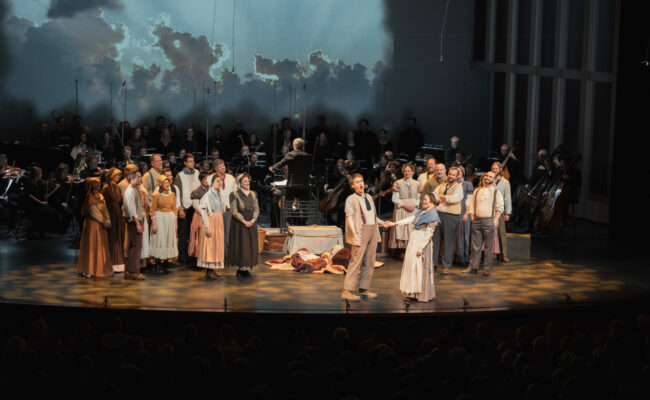
The South Dakota Symphony Orchestra wants to be where the people are.
That means a lot of places.
Of course, it’s at the Washington Pavilion, on the stage of the Mary J. Sommervold Concert Hall.
But it’s also in the classroom. At a cultural center. At a landmark. In a mid-sized city and in a small town. It’s wherever the people are, and however these professional musicians can bring the artistry and beauty of classical music to them.
“Our vision is to be the state’s artistic leader in how an orchestra serves its communities. We take that very seriously,” said Jennifer Teisinger, executive director, noting this is the 104th season of the Symphony. “In one form or another, this community has had an orchestra for almost as long as it’s been a community.”
The Symphony does what you would expect – concerts October through April, playing classic and modern works. But then it does what you might not expect – taking the music to the people across South Dakota.
There’s the Music Composition Academy, which is on both sides of the state, providing a weeklong summer camp for students to write their own piece of music. In the fall, the Dakota String Quartet and Dakota Wind Quartet go to those communities and perform the students’ pieces for their friends and family.
“It’s pretty cool to watch the students when the quartet is playing their music for the first time,” Teisinger said. After the performance, Delta David Gier, the longtime music director and conductor for the Symphony, will ask the students what they think. “The responses are all over the place, from ‘that’s much better than I thought it would sound’ to ‘I completely forgot what I wrote.’”
She laughs, but what happens next is transformational: Students return to the camp. Their compositions improve. They find their voice, their style and their rhythm as composers, and they watch it all come to life.
Maybe they’ll become professional musicians. Maybe they’ll keep writing. Maybe they’ll be lifelong fans of the Symphony and bring their grandchildren to performances. When the Symphony feels like your Symphony, you’re in it for the long haul.
And that’s exactly what Teisinger and Gier want.
“Every time there’s a new idea, we compare it to our vision, and then decide if it works or not,” Teisinger said. “These programs and projects are happening in communities that need it the most.”
Their outreach takes them to a variety of venues and a diversity of audiences.
“Everyone needs music in their life, and we don’t want anyone’s inability to come to a concert to prohibit them from having music in their life,” Teisinger said. They also tailor the performances to their audience – offering a sensory friendly experience at DakotaAbilities, for example.
‘Giants in the Earth’
There’s also, of course, the traditional programming from the stage at the Pavilion.
“There’s Beethoven and Brahms, and we introduce new music from time to time, or music of venerable composers the audience hasn’t heard before,” Teisinger said. “Our programming is interesting for our musicians, and we’ve become known for that. We are known for great programming and excellent music-making.”
The Symphony has received national attention and acclaim in the past few years for its culture and programming.
Gier believes “an orchestra is meant to serve its unique community uniquely.”
An opera about the Norwegian immigrant experience fits that bill – and the Symphony performed “Giants in the Earth,” based on the 1924 novel by O.E. Rolvaag, in 2025.
Any newcomer to South Dakota is urged to read the book, and Gier was no different. When he learned there was an opera, written by Douglas Moore and Arnold Sundgaard that won the Pulitzer Prize in Music in 1951, it became a goal for Gier to bring it to the stage.
“David told me, ‘If there’s any orchestra that should do this opera, that’s us,’” Teisinger said.
But, of course, that’s expensive.
“I told him, ‘I get it. I see where you’re coming from, but there’s no money for that.’”
Dream it long enough, and a solution will find its way to you. That’s what happened with the Symphony – a few conversations and a few national news stories meant a little serendipity – the right people at the right time heard about what the orchestra was doing.
A $2 million donation from Dean and Rosemarie Buntrock helped bring the opera to Sioux Falls.
The musicians and opera singers performed to full houses, and the Norwegian ambassador made an appearance. The New York Times covered the show. It aired on SDPB. And it was nominated for an International Opera Award.
This is the power of a community’s commitment to its Symphony – and the Symphony’s reflection of the unique community it serves. They’ve also done that through the Lakota Music Project, a collaboration between the Symphony and Lakota and Dakota musicians.
“The SDSO’s Lakota Music Project demonstrates friendship between Lakota/Dakota and non-Native peoples. Our statewide tours bring hope and healing to people in cities and reservations, showing a way forward and beyond the racism which has often characterized our past,” Gier said.
“It’s amazing,” Teisinger said. “The South Dakota community wants us to be deeply involved, and we try to respond to the call.”

Grateful to donors
The Symphony has a full year-round schedule, including its concert series. Upcoming programming includes the Shostakovich Festival in March, where the Symphony will perform Shostakovich’s Symphony No. 8. They also will screen the Soviet film “New Babylon,” with Shostakovich’s score performed live at the Goss Opera House in Watertown, as well as at SDSU and Augustana University.
“The film is in black and white, and about 15 musicians will perform the music,” Teisinger said.
The festival includes programming at SDSU, DSU and Augustana University, making it one of the bigger partnerships this season.
“Shostakovich’s music has a near universal effect on performers and listeners, engendering an inevitable question: what does this music mean? At once beautiful and powerful, his music gave voice to the Russian people under that Soviet regime,” Gier said. “But it resonates beyond politics, stirring within us the big, existential questions while engendering hope for a future which transcends the conflicts of the present.”
Teisinger is excited for the rest of the season and for the future of the Symphony.
But, much like how all the right pieces had to fall into the right places for the “Giants in the Earth” opera to finally come to Sioux Falls’ stage, supporting the arts requires people who care – and give.
“So many donors are passionate about the arts, and we see that in their giving,” said Andy Patterson, CEO of the Community Foundation. “The Symphony has become such an integral part of our fine arts community. Those who offer their continuing support through their philanthropy truly help keep it going.”
The Symphony has an endowment through the Community Foundation, and Teisinger said the generosity of the community has been invaluable to their work and their future.
“People in our community have placed their trust in us, and they invest in us, and we are a direct beneficiary of that,” Teisinger said. “The future of orchestras in this country, and the South Dakota Symphony, is in philanthropy.”
Sioux Falls' art scene continues to grow thanks to a generous community.
Read More
The Waltons' legacy of philanthropy and community leadership continues to inspire in Sioux Falls.
Read More