
Paul and Koni Schiller create a legacy of art
Sioux Falls' art scene continues to grow thanks to a generous community.
Read More

When Sharla Keyser drives around Sioux Falls, she sees her parents’ influence.
From the thriving downtown – where her mom, Pat Walton owned Kitchen Cordial for nearly 20 years – to Phillips to the Falls, where her dad, Jerry Walton, helped influence smart urban planning for a growing city – their imprint is everywhere.
“When I drive around town, I’m like, ‘Mom, Dad, Mom, Dad.’ They had their hand in so much,” Keyser said. “There’s a lot of people that do a lot of good, and everybody knows, because they see their name everywhere. You don’t see Walton on stuff. That’s intentional. They were very humble, gracious servants.”
Pat and Jerry Walton continue to be remembered for their generosity, and their longtime support through the Community Foundation. They were honored as Friends of the Foundation in 2005. Jerry died in 2024, and Pat died in 2022. Their tradition of philanthropy continues as their five daughters help advise their family’s endowment at the Community Foundation.
“They were some of the best people I’ve ever known,” said Andy Patterson, CEO of the Community Foundation. “They truly had a culture of community leadership and generosity. Their sense of responsibility and desire to be positive about the future of Sioux Falls was inspiring.”
Keyser said her family has been involved with the Community Foundation almost since its start – she remembers Rosemary Draeger, one of the founding members, bringing paperwork for her mom to sign at Kitchen Cordial in the 1980s. Giving through the Foundation was one way they could invest in the community, Keyser said. Community leadership was important to Pat and Jerry, and they did that not only through their generosity but also through involvement and advocacy, Keyser said.
Deep community roots
Pat found purpose in her work at Kitchen Cordial – she opened the store on Phillips Avenue before it was the thriving business district it is now, Keyser said. But Pat knew downtown could be a hub, and she brought other women – business and community leaders - together to help re-imagine the area.
“They met ritually every week, and they helped hire the first Main Street director,” Keyser said of the group of women.
Jerry had a similar desire to influence the direction of the city. He served as the chair for Sioux Falls Tomorrow – a major community-based planning initiative that continues today. Keyser said her dad knew Sioux Falls had potential.
“He thought it was important to make sure the city was ready for the growth he knew was coming,” Keyser said. “He saw other cities who were just haphazard about it, and he wanted to make sure we were thoughtful.”
Jerry had a long commitment to South Dakota, having spent five years as a rural family practice physician in Martin, South Dakota, and leading a variety of community initiatives during his career.
Keyser said her parents encouraged their children to be active in the community. And while she’s enjoyed a career at various nonprofits, she still is inspired by how her parents were so deeply involved, including work with First United Methodist Church and Dakota Wesleyan.
Jerry also started the Growing Healthy Community Initiative, which brought health education to the public. The Community Foundation acted as a fiscal sponsor for the program. He also started a radio call-in show and was the founding director of the first Muscular Dystrophy Clinic in South Dakota.
“Jerry always rolled up his sleeves to help make things happen,” Patterson said.
Life lessons
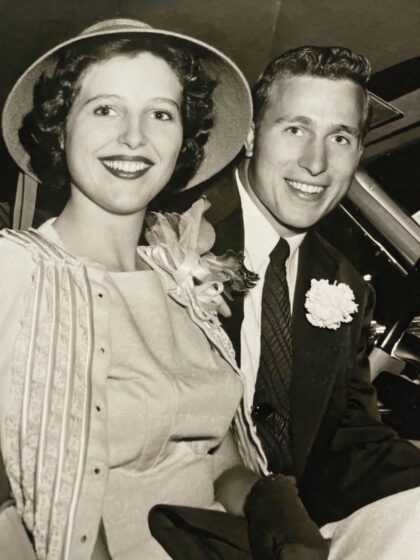
Pat and Jerry grew up children of Methodist ministers and moved around the state. They met a few times over the years but became closer during their time at Dakota Wesleyan. Jerry’s medical school studies took them to the University of South Dakota and then Dallas. With three daughters in tow, they moved back to Martin, South Dakota. There, they welcomed two more daughters. After a few years, they moved to Sioux Falls.
Keyser said her parents instilled a lifelong love of learning.
“They were always challenging us and asking, what else can you learn, or what else can you do,” Keyser said. “It didn’t matter to them how we did it, but just that we kept growing, learning and challenging ourselves. They knew that looked different for everyone.”
They also modeled how to always make space for generosity, starting with regular giving to their church.
“My parents, even when they had nothing, they faithfully set aside 10 percent first for the church,” Keyser said.
When the girls began getting an allowance, there were three jars lined up.
“One was our church jar. So, right off the bat, if we got 50 cents, then 10 percent went in the church jar, and then 10 percent in our savings jar,” Keyser said. “We could spend the rest – but they would make us think carefully about what we were spending it on.”
That generosity continues. One daughter gives regularly to her church, another coaches people through healthy living, reminiscent of her dad’s early initiatives. And there have been family members who have benefited from the nonprofits others give to – reinforcing the importance of giving to community organizations.
“It’s a reminder to us, of why we do what we do and why our parents did what they did. You never know when it will be that season that one of us will need to be not the giver, but the receiver,” Keyser said.
It’s part of how their parents gave – often giving locally, where their philanthropy could be felt.
“We were made for relationships,” Keyser said. “No funding from far away can do that. But giving locally, where there are boots on the ground and people doing the work, those types of things can make all the difference.”
Modeling kindness
Modeling generosity and civic leadership is important, but what Keyser really talks about was how her parents treated each other – and other people. That’s a legacy that’s hard to quantify.
Pat worked to help put Jerry through medical school, and Keyser said he always gave her credit for his career. “He always said it wouldn’t have happened without her,” Keyser said. “He said it over and over, to make sure we knew it. He made sure our husbands knew it.”
Keyser said witnessing her parents’ love for one another was yet another gift they gave her and her sisters. As her parents got older, they took their meals side-by-side on the couch, where it was just a bit easier to sit.
“They had this oversized TV tray they would put their food on,” Keyser said. “They would sit down, hold hands, bow their heads and pray together. Then, they’d wait, and give each other’s hand a little squeeze when they were done. When they’d both squeezed, they’d look up and give each other a kiss.”
It’s a memory of love and kindness that Keyser cherishes.
“You’re just witnessing something so special,” she said.
Keyser said her parents’ legacy lives on, and she regularly hears from people who say they were active in the community because of her parents’ example.
“My parents impacted so many people and motivated others to give, and hopefully those people model that with their families, so that generosity grows exponentially over time,” Keyser said. “My parents never did these things for attention – it was just something they did. And that’s what they taught us. To be humble, gracious and grateful. It’s truly a lifestyle.”
Sioux Falls' art scene continues to grow thanks to a generous community.
Read More
Sioux Falls' couple continues to invest in programming that supports financial literacy for students in Sioux Falls.
Read More