
Pat and Jerry Walton led with humble, gracious generosity
The Waltons' legacy of philanthropy and community leadership continues to inspire in Sioux Falls.
Read More

If you ask Dusty Miller a question, he’ll answer with a story about his mother.
“I am my mother’s son,” he says, nine times out of 10 when asked where he learned something, what inspires him and who he admires.
It all started on the North End of Sioux Falls, where his parents raised five sons at 10th and Menlo.
“If you were going to the Black Hills, you drove right in front of our house,” Dusty said. They had moved there from Watertown in 1952, and his parents, Roy and Waneta, wanted to open a business. They started Midwest Jack Service, which his brother Greg took over when their father died when Dusty was 8.
This is another point where he tells a story. His brother would take the jacks apart – down to the ball bearings – and, after school, Dusty cleaned each piece.
“I would spend my time with wire brushes on these old hydraulics and get rid of every bit of dirt and grime and gravel and get them all clean. They would dry overnight, and my brother would put them back together the next day,” Dusty said, noting the jacks would be tested and painted and good as new. “I got paid 15 cents a jack.”
Dusty learned a few things about himself in those evenings cleaning parts. The first is that he was good with his hands, good with the details. The second was that he was thoughtful about money – knowing what a job is worth and what to do with the money you make.
Waneta made him save money for college, and when that was saved, he could begin saving for a car, but not just any car: He had to buy something decent, not an old junker that would nickel and dime him to death.
“You have to understand, Waneta was born in 1917, and she was the oldest with siblings she took care of,” Dusty said. As a teenager, she saw the stock market crash and the Great Depression hit. When she was older, there was World War II, where Roy served from 1941 to 1945. Waneta was 40 years old when Dusty was born.
“Now I have all that wisdom of what she lived through, and that’s coloring my life,” Dusty said.
Dusty went to college at the University of South Dakota, where he hoped to become a doctor. One semester of organic chemistry sent him across campus to the business school instead. In summers, he worked in landscaping.
Out of money for his last semester at USD and pretty close to dead broke – as he says – he applied to C&R Supply, where the only thing they cared about on his application was that it was legible. He got a job as a delivery driver, delivering lawn and garden supplies, thanks to his handwriting and a recommendation from the landscaper he had worked for in college.
Long story short, Dusty bought the business in 1998 and sold it in 2012 to three of his employees. He glosses over building a successful business and passing it on to the next generation. Instead, the next story he tells is about Adopt-A-Highway.
“Back in the early 90s, Kathy and I volunteered to help clean a stretch of the highway our car club adopted,” Dusty says. “It is an unelected position, so apparently it’s ours for life.”
Rather than have the county come pick up the garbage, Dusty would haul it to C&R Supply dumpsters to dispose of it. “When I sold C&R, there was a mutual agreement I could continue to use the dumpsters,” he says, laughing about his lifetime access to them.
It’s how everything goes with Dusty. He stops mid-story to ask if he’s boring you. What he doesn’t realize is he’s a great storyteller. And as John Updike would say, you can slide right down his voice into his living room.
Kathy sits on the couch beside him. It’s a house she designed. Picture windows bring the outdoors in, and everything feels warm and spacious. Birdfeeders crowd near a dining room window, perfect for watching with morning coffee.
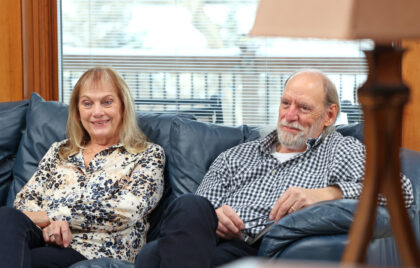
Dusty met Kathy at The Time Out Lounge, a former sports bar near the Arena, one summer and they were engaged by Christmas.
“I was pretty sure she was the one, and I had to nail that deal down,” Dusty says with a laugh. That was 37 years ago.
Kathy grew up on a farm and studied at Nettleton College. She was a bookkeeper and office manager for Christopherson, Bailin and Anderson, working as a legal assistant for their senior partner, who was Marv Bailin.
Bailin, of course, was one of the founders of the Community Foundation.
She retired in 2017, but she still stops by every month to say hello, and it was Kathy who introduced Dusty to the Foundation, where they have a donor advised endowment, which helps them simplify their giving.
When asked where they learned to be philanthropic, they pause and look at each other. Kathy is thoughtful, and Dusty pops in with a story. This time, it’s about the Boy Scouts, the church and, of course, Waneta.
“I am my mother’s child,” Dusty says again. “She had a full house, and the whole time we boys were coming up, we were all told that no matter how much money she had, don’t wait around for her to die to get rich. Go make your own way, because the money she had was going to the church, the library and Sioux Falls College.”
After Waneta’s death, a scholarship she established was transferred to the Community Foundation for management.
Kathy thinks for a minute.
“I worked for Marv for years, and he was always doing something for someone. People used to tell me how tough he was to work for, but I never saw that side,” she says. “People out there need help, and we can do that.”
Mary Kolsrud, chief philanthropy officer with the Community Foundation, said Kathy and Dusty are visionary – building an endowment during their lifetime.
“They care so much about this community, and they understand the power of an endowment to make more possible,” Kolsrud said. “They show that not only with the programs they choose to support, but through the thoughtful way they are building this endowment. It’s inspiring.”
Dusty and Kathy are both passionate about money matters. They’ve helped fund the Making Cents program through EmBe to teach financial literacy to young women. They give to Junior Achievement. Most recently, they gave to the Boys and Girls Club to fund a financial literacy program at the George McGovern Middle School location.
They firmly believe young people need a better understanding of how to invest, what compounding interest is and how to make responsible financial decisions.
It isn’t that Dusty thinks the next generations are any less capable – it’s that they just don’t always have the tools they need. It’s why they both support programs that teach those skills.
“If one kid out of each class, or two kids, avoids this crazy trap of being in debt their whole life, then it’s worth it,” Dusty says.
They’ve spent time at a simulation with students in Junior Achievement, watching them learn to budget with different family scenarios and different household income amounts – what happens when you need daycare? What happens to your clothing budget at different income levels? Where can you save money?
They’re real-world scenarios that the Millers think can help young people visualize situations that might happen – and show them the consequences of their financial decisions.
Dusty has another story. His job growing up was to put the dishes in the dishwasher. He earned a nickel a day, and their parents kept track of payments to the kids in a ledger they called “The Book.” During daily errands with his dad, they would stop at Ken’s DX gas station, and his dad would slip him a nickel for candy or a pop.
“I thought I was in pig heaven, getting a candy bar a day, plus I was making a nickel a day loading the dishwasher,” Dusty says. One day, he asked to see his grand total in the book.
Turns out, that nickel he made every noon in the kitchen was the same one his dad gave him to spend every afternoon in the gas station – and he had no balance in “The Book.”
He laughs. It was a good money lesson for a young Dusty. “I wanted my nickel back!”
He stopped accepting the nickel from his dad every day, so he could grow his balance in the family ledger, like his older brothers.
They settle back on the couch. Kathy smiles.
The house is quiet, and they talk about their giving. The Community Foundation makes it easy for them to send donations to various causes, they say. Some of it’s ingrained – Kathy watched her boss model it for decades. Some of it’s exposure – they learn about local needs and how they can help through the Community Foundation.
But really, what drives them is hope. They might not use that phrase, but it’s behind everything they say, and much of what they do.
“Five years from now, 10 years from now, some kid is going to make a good choice – or not make a bad choice,” Dusty says. “And it could be because of something they learned in one of these programs.”
The Waltons' legacy of philanthropy and community leadership continues to inspire in Sioux Falls.
Read More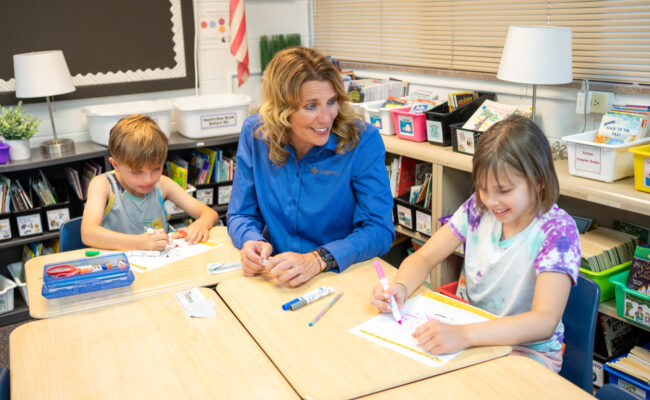
Workshops and classes offer real-world scenarios to teach financial literacy to students across South Dakota.
Read More