
Jeff and Linda Baka support causes that help women stay healthy
Jeff and Linda Baka have been inspired to give to women's health programs, such as All Women Count, because of their own experiences and careers.
Read More
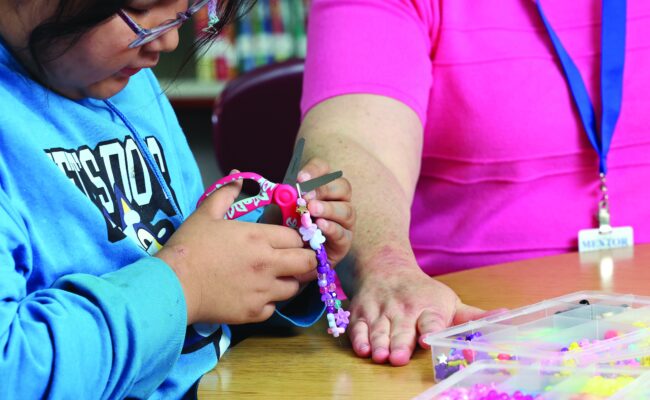
Chris Olson slides a tiny bead across the table.
“Do you want stars? Or hearts? What about purple,” she says, picking different beads out of one of the stacked plastic cases.
Grace, 10, eagerly takes them.
“Yes!” she says, as Chris suggests metallic beads.
The two of them, heads bent, are deep into the work of creating bracelets, rings and just about anything you can make with beads and stretchy string. Grace works so fast, Chris mostly serves as a bracelet apprentice, suggesting designs and admiring Grace’s work. In between, they talk about Grace’s two cats and the cartoon Bluey.
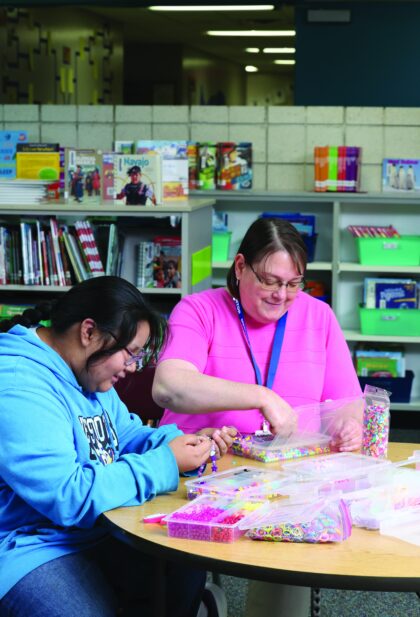
It’s a typical scene on a Thursday at Terry Redlin Elementary School in central Sioux Falls, where mentors gather over lunch to play games, make art and talk with students. On any given day, about five mentors and their mentees gather each lunch period.
Chris and Grace started meeting in December. It’s the first time Chris has mentored, and, so far, she loves it.
“I’m having more fun than I should,” Chris says with a laugh. “I go back to work, and I’m giggling. It’s nice to have an excuse just to play.”
Grace likes it, too. She teases Chris about the times when she’s spilled the beads. They have an easy way between them, little jokes and laughs and a running commentary on which My Little Pony they like the best.
Finding new mentors
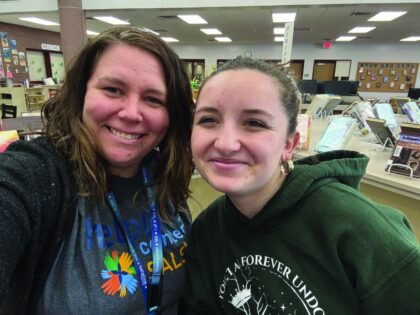
Finding mentors and helping match them at Terry Redlin, Cleveland and Anne Sullivan elementary schools is a full-time job for Jenna Lilyquist, of the Helpline Center.
The position, which began last fall, is funded in part through a grant from the Sioux Falls Area Community Foundation, which also serves as a fiscal sponsor for the program. The goal is to increase mentorship at these three schools by working with nearby businesses, churches, civic groups and neighborhoods.
“We are very close to doubling the number of mentors we had at those three schools,” said Lilyquist, who noted more than three dozen new mentors had signed up since the fall.
It doesn’t mean the waiting list for mentors has diminished. Instead, students see how much their friends love meeting with mentors and ask to be included. Teachers and counselors also keep an eye out and recommend students who might benefit from having a mentor. They still need more than 100 new mentors.
Studies show students with mentors earn better grades, attend school more regularly, graduate at higher rates, and live more productive lives. The three schools in this pilot program are in underserved areas and struggled to attract consistent mentors for students. Lilyquist said sometimes potential mentors worry they won’t have time to leave work or are unsure how the relationship will be. She’s quick to address all of that.
Mentors come during the school day, typically over a lunch hour, and can be flexible on which day it is. And mentors are asked what works best for them – down to what kinds of activities they like to do and how they want to work together.
Maybe someone loves playing Uno, playing basketball or reading. The organizations will find a way to match people with similar interests, in the hope that it works for both sides.
For Chris, she just kept hearing about the program. She works at the Helpline Center and sits near Lilyquist. She would hear her talk about the mentoring program and think, “oh, I should recommend my nephew as a mentor,” she said.
She started considering mentoring herself and asked her supervisor if it was OK to leave for an hour a week to volunteer. “Every week, I look forward to it,” she says now. “When else do you get to just go play? There are no projects that are overdue. You just get to go have fun.”
Lilyquist said word of mouth goes a long way in recruiting people. “It just takes one person saying, ‘hey, I know what kind of person you are, and I think you’d be a good fit for this,’” she said.
Culture of volunteering
She shares a story of her own mentoring experience.
Her mentee is in high school now, but they’ve been paired together since she was in sixth grade. Right away, she wanted to teach Lilyquist how to crochet. They started with making a chain. They progressed to granny squares and spent nearly every mentoring session for the better part of two years crocheting together. Now, Lilyquist is working on a blanket.
“That’s one of the most meaningful things you can do – let them teach you how to do something,” she said. “Now, every time I talk to someone about crocheting, I get to say my mentee taught me how to do this. Then I go to the school and get to tell her, ‘I was talking about you and how great of a teacher you are.’ This builds her confidence. She knows she’s a good teacher, and I’m out in the community bragging her up.”
Crocheting has turned into Lilyquist’s favorite hobby – and she learned it all from her mentee. “I crochet all the time,” she says with a laugh. “I’m the person carrying the yarn basket.”
Andy Patterson, CEO of the Community Foundation, said participating in community-wide programs like the mentoring initiative can be good for a lot of reasons.
“I started mentoring this year, and many people on our staff have begun participating as well. It’s been a great way for us to get involved and be a part of this effort,” Patterson said.
Lilyquist agrees.
She estimates school-based mentoring is about a 40-hour per year commitment – to account for travel to and from the school and 40 minutes of mentoring per week.
“If there’s a culture of volunteering within a business, it’s a lot easier for someone to say ‘I’m going to step out to mentor, and I’ll be right back,’” Lilyquist said. “If a business can build that kind of culture, it’s a powerful way to give back consistently within the community.”
Lilyquist said mentors find community – getting to know their student but also other students and mentors and school administrators.
Superintendent Jamie Nold agrees.
“You don’t need any special skills – just a small amount of time each week and a willingness to listen and laugh. I’ve been mentoring for 10 years now, with three different students, and I can honestly say it’s the easiest and most rewarding thing I do each week.”
Call 211 or visit the website to sign up to volunteer.
Jeff and Linda Baka have been inspired to give to women's health programs, such as All Women Count, because of their own experiences and careers.
Read More
Abbott House is raising money to build two more intensive foster care homes in Sioux Falls that help transition young adults from foster care to independence.
Read More